info
/
Slow Release
Artists’ studios Tel-Aviv, Curator: Eitan Buganim
Slow Release (2016)
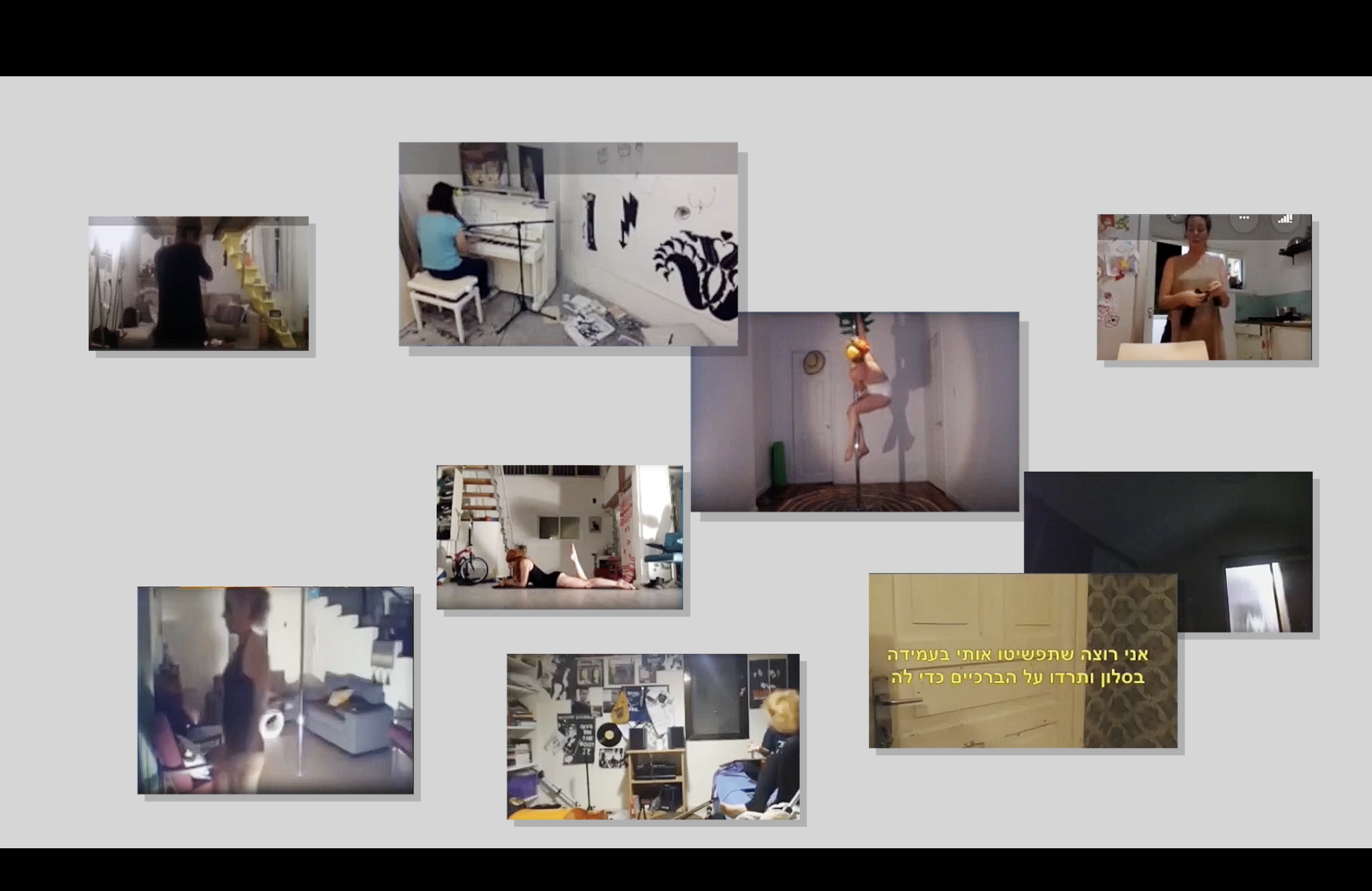
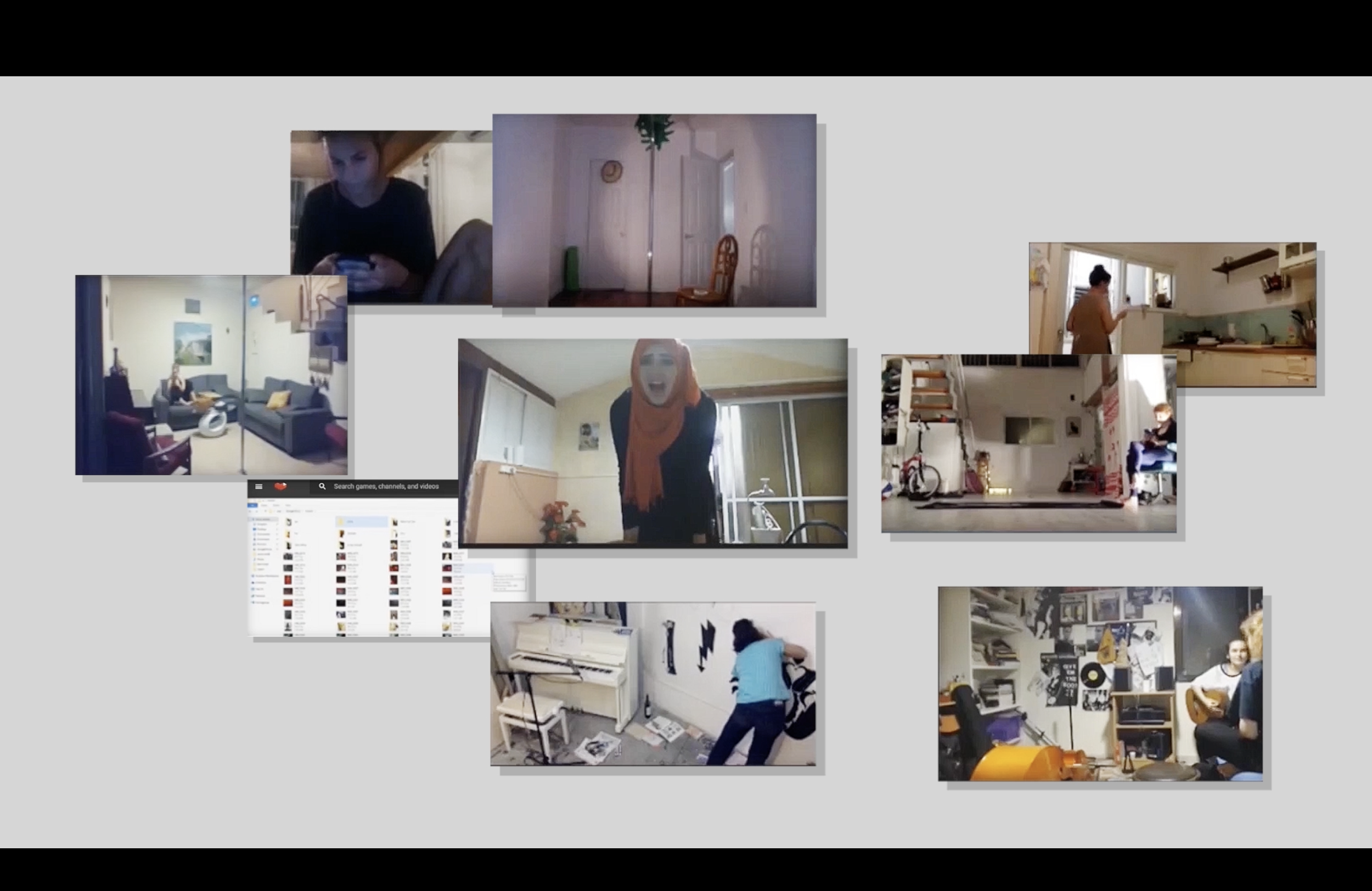
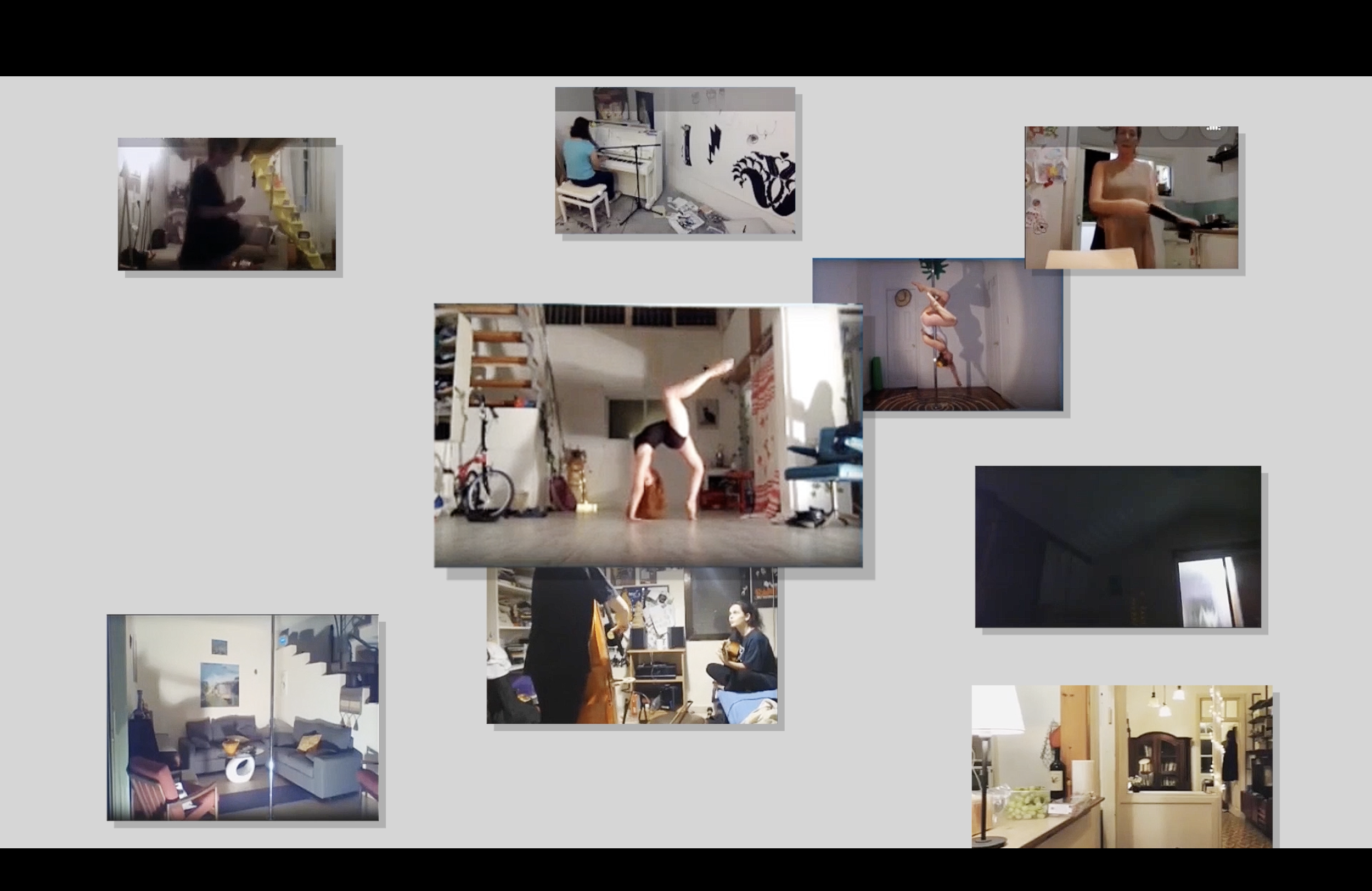
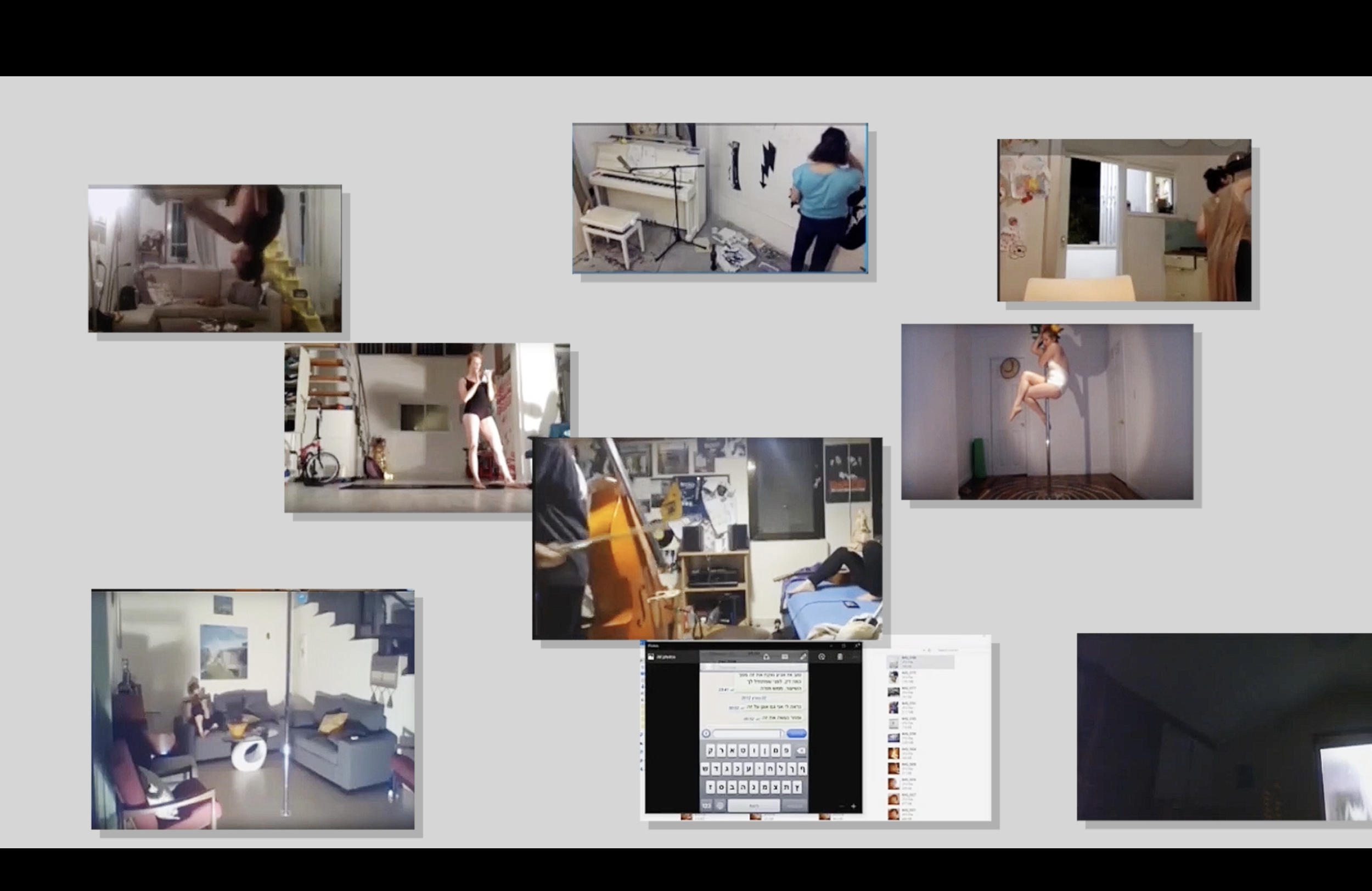
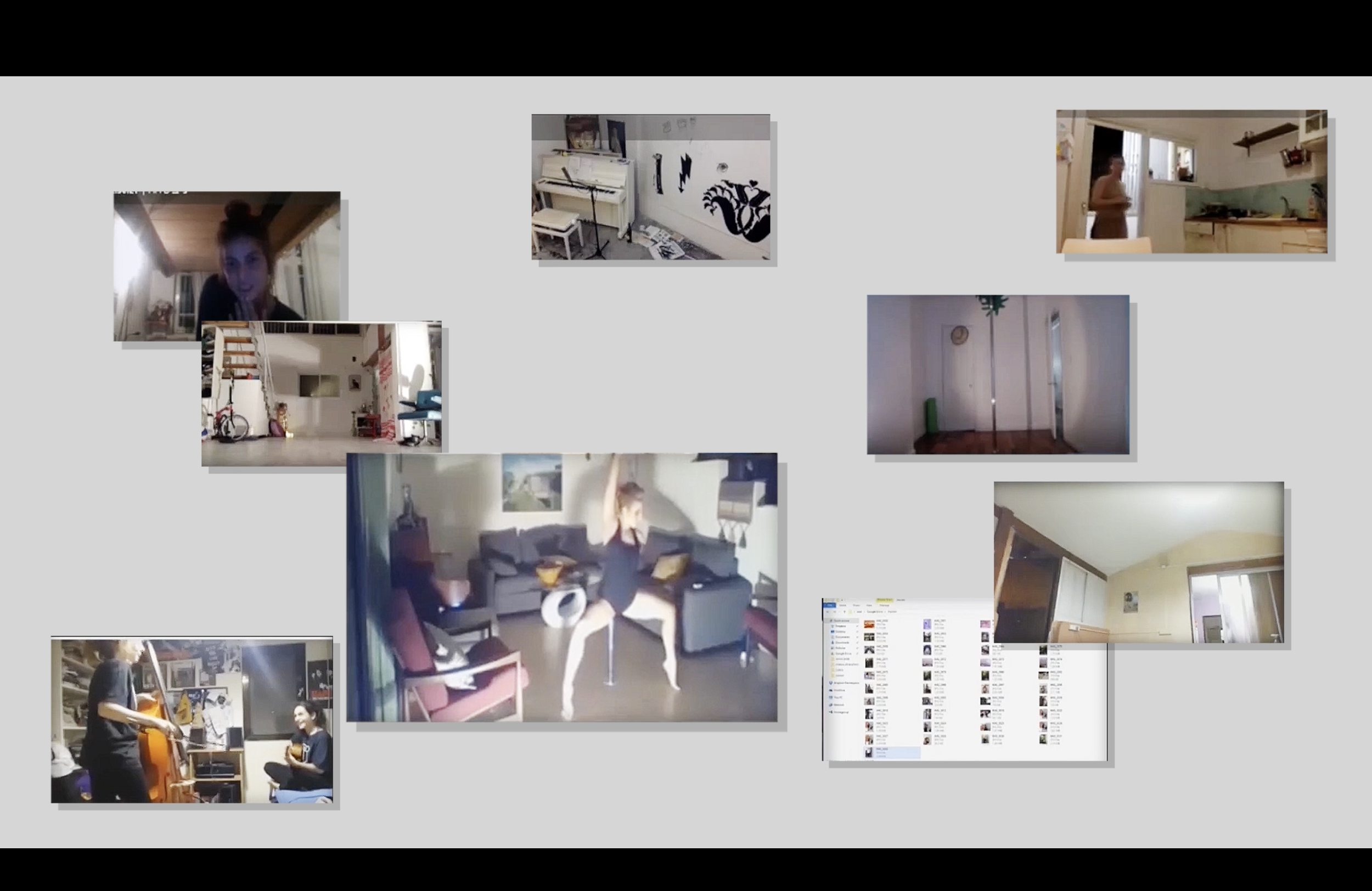
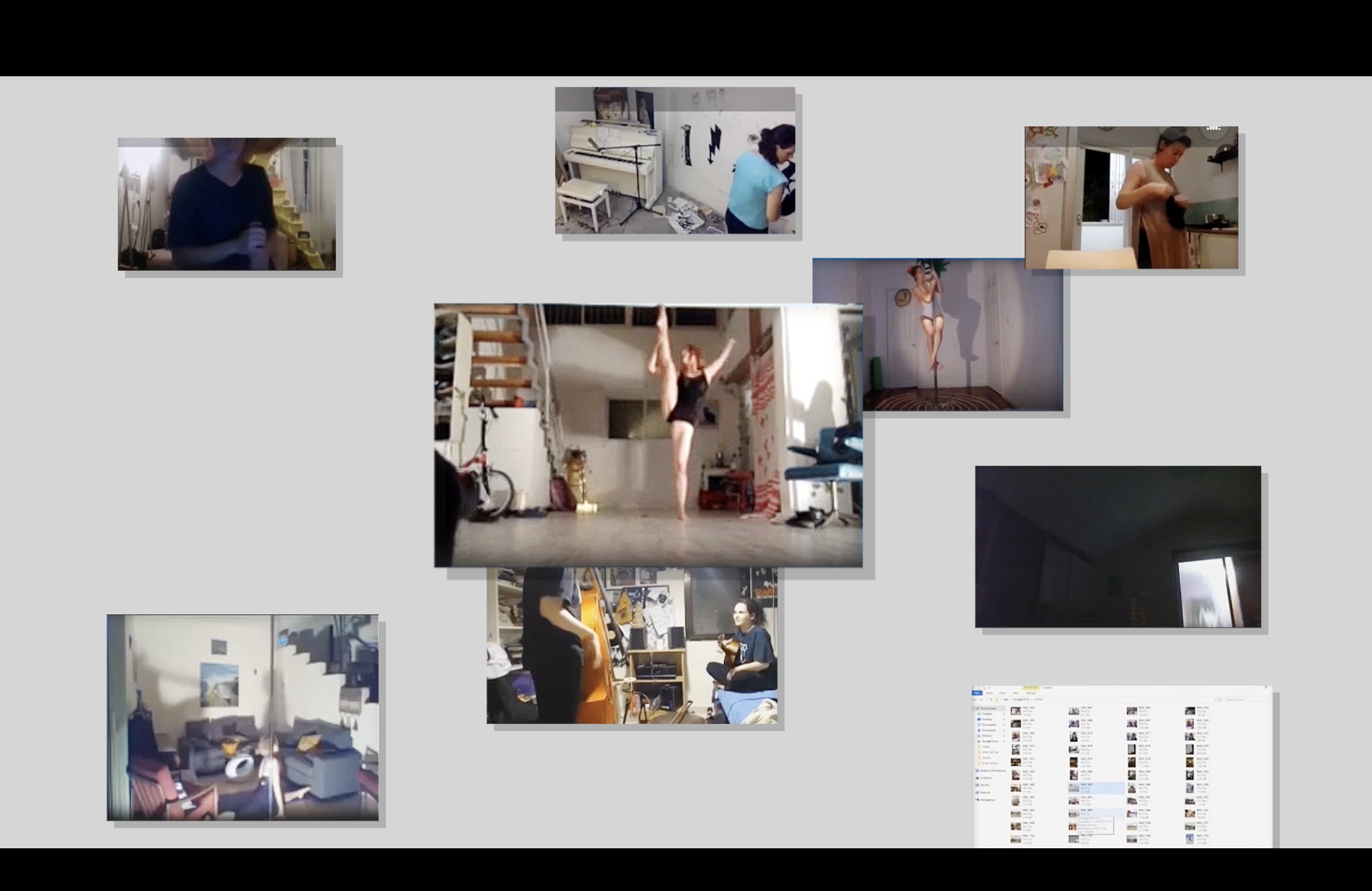
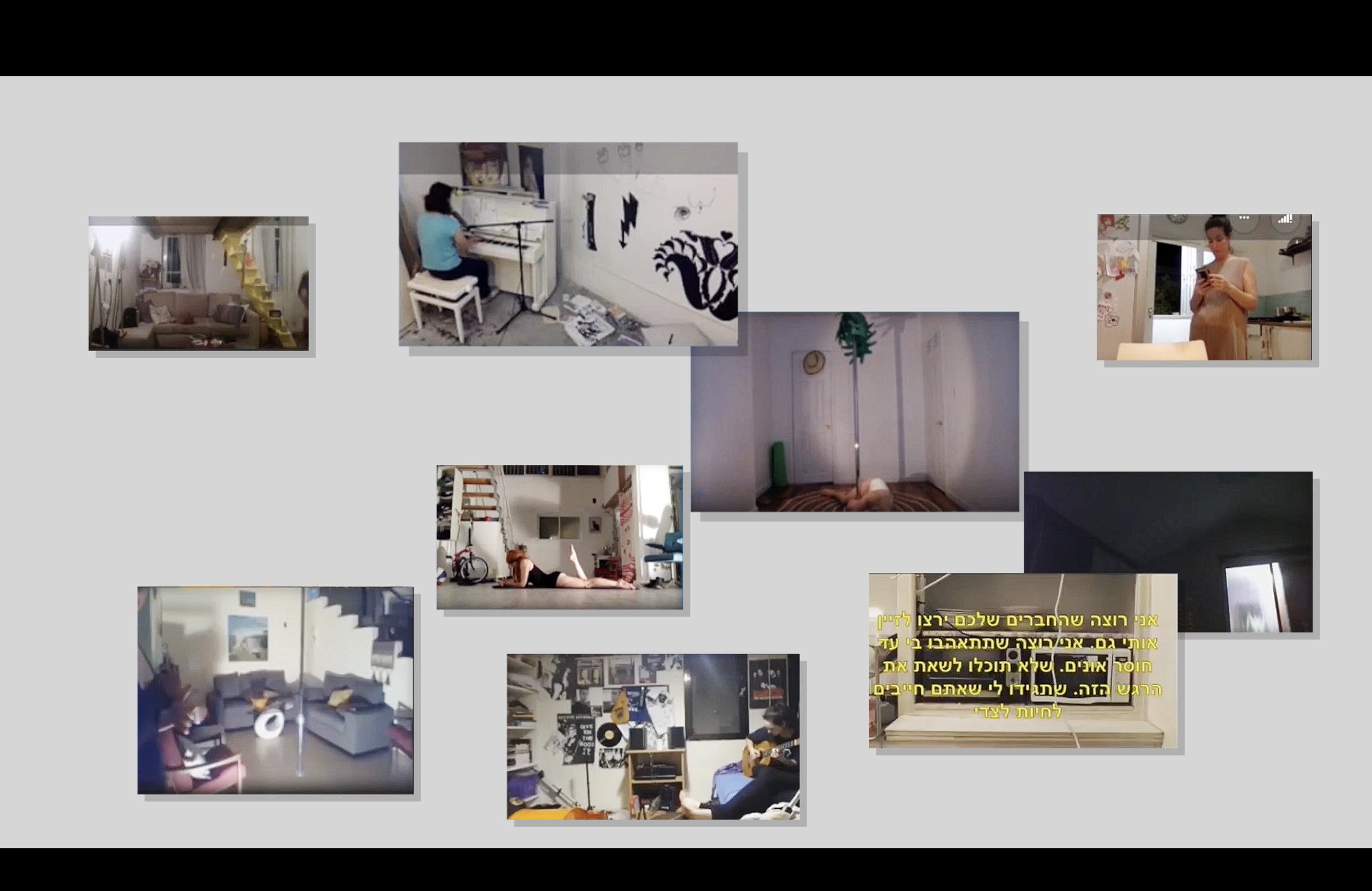
Broadcasted performance, 9 channels, 180 min
SLOW RELEASE
Tamar Katz
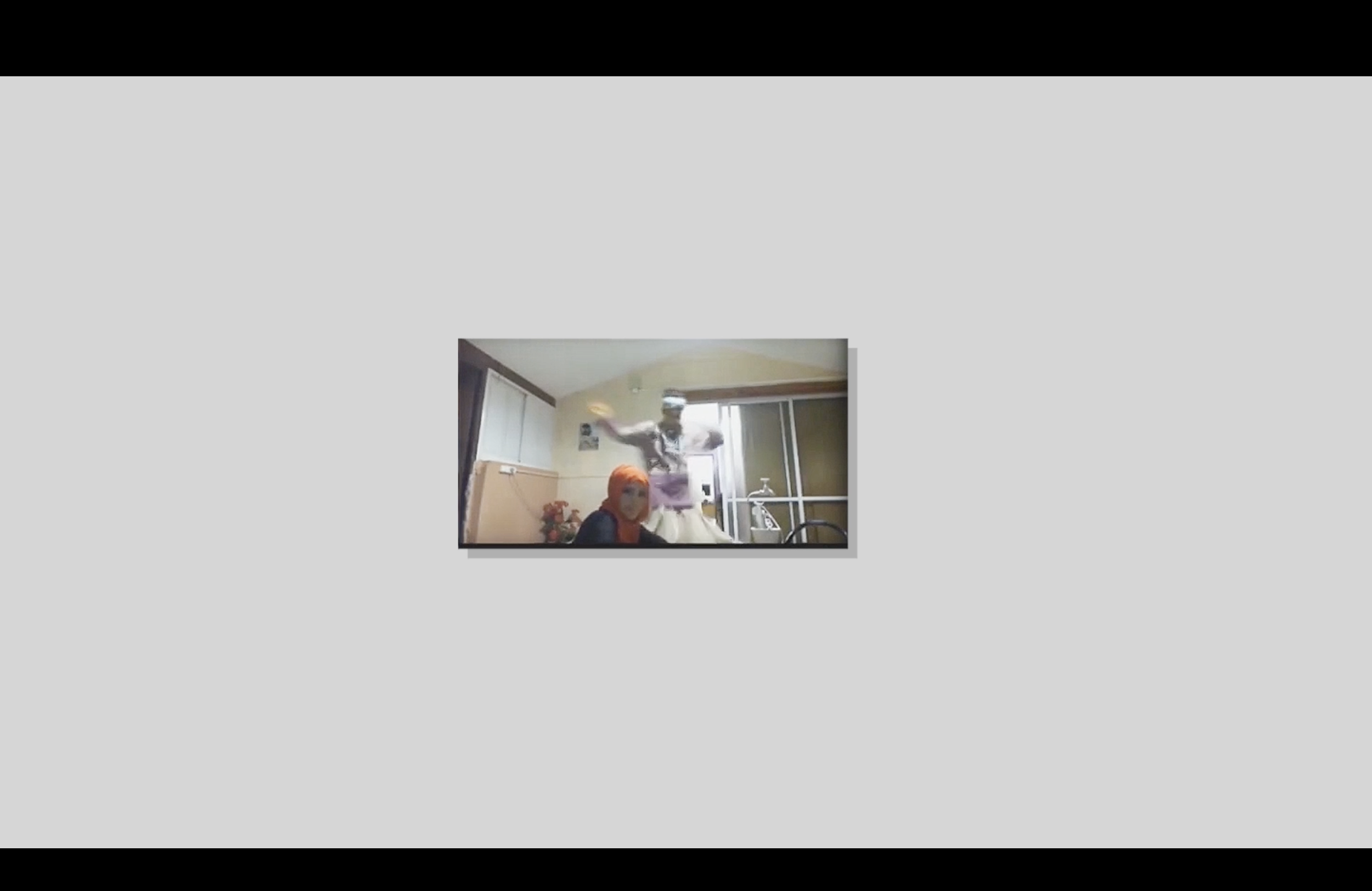
Aysha E. Arar: An art student from Jaljulia who creates vocal performances. As a religious Muslim woman in Israel, Aisha's voice is heavily charged with gendered and political meaning. Because the prohibition of women's singing in Islam prevents her from being heard on many public stages, her performance from a domestic space—broadcast from a home in Thilith, West Bank—becomes a significant act of navigating the traditional and artistic spheres.
Shira Rosenblatt: A graduate student in psychology and a pole-dancing instructor. Her love for dance never previously left the studio; performing from her parents' home allowed her to overcome stage fright and perform for strangers for the first time.
Annabelle Paran: A graduate art student based in New York. For this project, she created "The Strength Test," marking the floor in concentric, shrinking circles until she was left with no space to move. She then climbed a pole in the center of the room, hanging until total exhaustion—a 20-minute struggle that ended in a dramatic, silent collapse.
Deaf Chonky (Tami & Adi): Aged 17 and 18 at the time of the project, this duo represents the "YouTube generation." Performing from Adi's teenage bedroom in Rehovot, they treat the camera and the internet broadcast as a trivial, everyday platform for sharing their music.
Rona Shpiller: A circus artist who has been writing privately from a young age. In her performance, she reads stories and reflections, addressing an invisible audience with an intimacy that makes the public broadcast feel like a meeting between old acquaintances.
Tal Bar-on: A visual artist and musician. Her cluttered studio, featuring a white piano, becomes an informal stage where she plays with her back to the camera, allowing for an intimacy where the audience is "present-absent."
Tamar Agmon: A writer and editor. Performing while cleaning her kitchen, Agmon breathes life into her debut text. Her actions echo Martha Rosler’s challenges to the boundaries of the artistic sphere, transforming the kitchen into a place where art grows.
Daniel Itzhaki: A flexibility and pole-dance instructor. Utilizing the walls, ceiling beams, and windowsills of her home as part of her choreography, she makes "staying at home" inherent to her grueling physical practice.
Michal Zoran: A producer and entrepreneur. Zoran chose to perform through impressions of her life rather than her physical body. Using software, she sent the audience images of her home and texts revealing her desires, interspersed with the TV series she was watching at the time.
Slow Release (2016) is a multi-participant performance project that took place simultaneously across nine different homes—both in Israel and abroad—and was broadcast live to the Artists’ Studios in Tel Aviv. Following the live event, the recorded sessions were presented as a video installation in the gallery space.
Presented in 2016—years before the global normalization of video-chat culture and remote living—the work anticipated the domestic space's transformation into a public stage. In the early years of social media live-streaming, Katz utilized these emerging tools to explore the home as the origin of all creation. These broadcasted performances took place within the private domains of women, encompassing textual, movement-based, and musical works that unfold slowly, away from the typical glare of the spotlight. The hermetic nature of the domestic sphere was breached by the camera’s eye, allowing the creators to reach a distant audience through a mediated lens, creating a space for mutual reflection.
Katz investigates the home as a territory that allows these works to exist within their own time, pace, and atmosphere—emerging alongside the familiar objects of daily life. The participants reveal works originally created "for the drawer," or pieces whose exposure had been deferred due to hesitation or fear. Here, the domestic stage acts as an intermediary space—a conduit that allows the creative body to flow outward without occupying a physical "place" in the public world.
By embedding the act of creation within the mundane, Katz frames art as an inherent component of private time. The work functions as an inversion of the reality-TV impulse for exposure; instead, it presents a desire to return to the most fundamental conditions—to the moment before total visibility and the urgency of the public gaze. Within the domestic space, delicate elements—spontaneous gestures, unconscious preparation, the handling of personal objects—become an integrated compound within the presented work.
The homes vary—from parental houses and temporary dwellings to spaces shared with sleeping children or entirely private sanctuaries. Each woman negotiates with her home as a place that enables creation but also facilitates surveillance, prevention, and even censorship. Performing from the home suggests an expansion of the "medium of the body" within the everyday, utilizing the social and cultural codes embodied by each woman. The work does not demand a "humanistic" gaze that infiltrates the home, but rather continues from the departure point of Chantal Akerman’s Jeanne Dielman and the works of Martha Rosler. It positions the act of staying inside as an unpretentious choice, seeking to tell the story of the creator in her privacy rather than her desire to claim a foothold in the external world.